

Construction
What Victorian actually means.
The Victorian era runs from 1837 to 1901, but most of the housing stock people mean when they say Victorian was built in the railway and manufacturing boom of 1870 to 1900. Roughly 4.7 million homes in the UK are pre-1919, around one in five dwellings, and most of those are Victorian. The cohort is overwhelmingly terraced, in long streets running off main arterial roads in cities, with smaller numbers of suburban semis and detached villas from the wealthier end of the era.
Walls are almost always solid brick, typically 9 inches (230 millimetres) thick for an inner London or terrace-of-workers house, sometimes 13 inches for a more expensive build. Cavity- wall construction barely existed in this era, and the small late-Victorian minority that did adopt cavities did so in the 1890s onward, in speculative suburban estates that read visually more like an early-Edwardian or interwar suburb than a Victorian street. If your home is cavity-built and post-1900, the 1930s house guide is the closer fit.
The other Victorian standards worth naming. Ceilings are typically 2.6 to 2.9 metres, taller than the 1930s norm, which means more room volume to heat. Original heating was fireplaces in every habitable room, fed by coal, with no central system at all. The kitchen range did hot water through a back- boiler arrangement. Lofts are usually generous, unboarded and accessible. Roofs are slate over timber rafters. None of these directly matter for a heat pump going in today. What matters is the wall fabric and what the planning authority will let you do to it.
Walls
The solid-wall question.
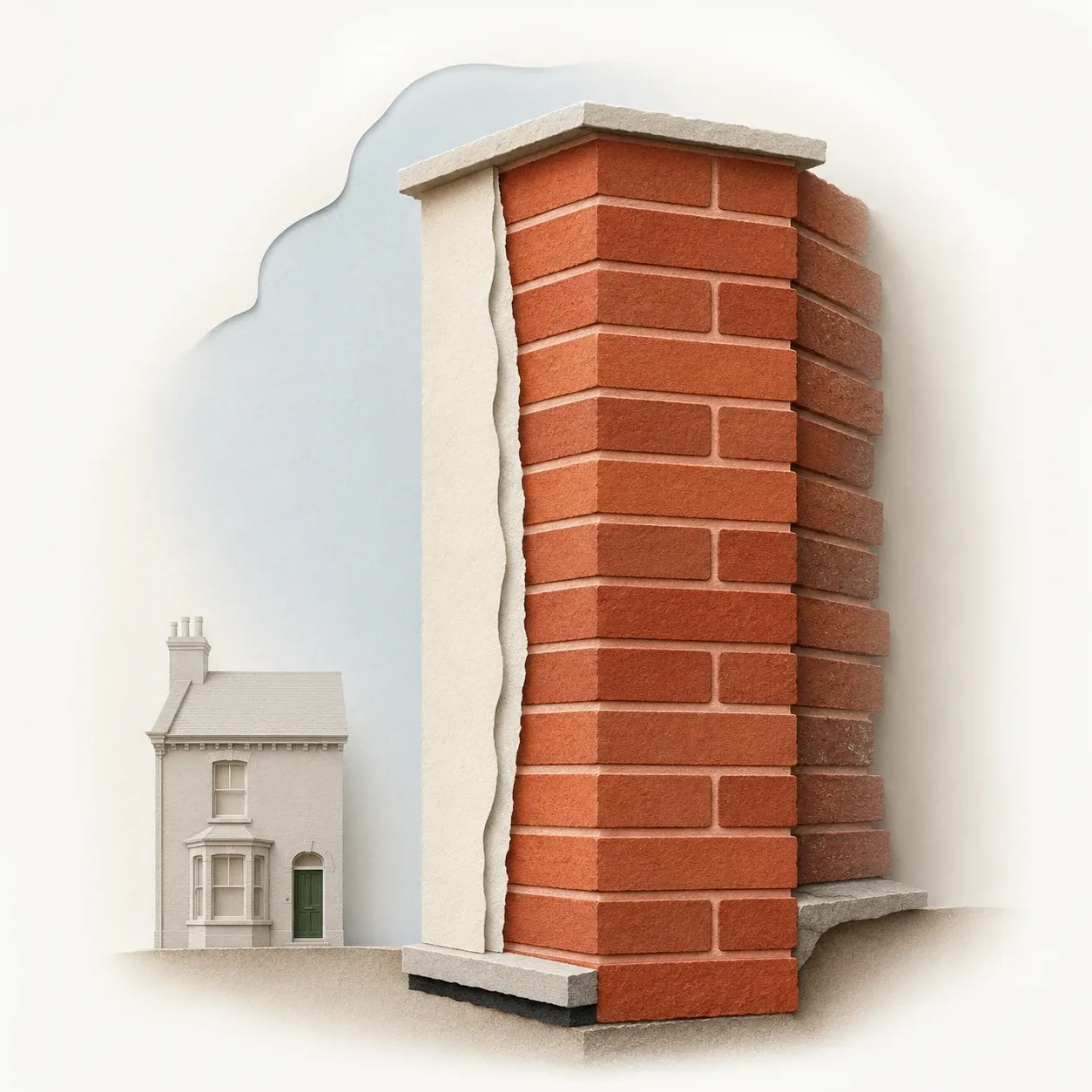
A heat pump fits a Victorian house comfortably as a technology. Modern monobloc air-source heat pumps (ASHPs) rated to operate down to between -20°C and -28°C outdoor air sit well inside the building-services design temperature of -2 to -4°C used across most of England. The Energy Saving Trust's Electrification of Heat trial, which monitored 742 ASHPs across a broad mix of UK housing including Victorian mid-terraces, found no statistically significant variation in seasonal performance by architectural era. The technical question is settled.
The financial question is the open one, and solid 9-inch brick is the central variable. The Building Research Establishment's in-situ measurements (BRE Output 290-102) put an uninsulated solid wall at a U-value of around 1.49 watts per square metre per kelvin. A well-retrofitted solid wall with internal wall insulation (IWI) or external wall insulation (EWI) drops to 0.5 to 0.7, similar to a filled cavity. That ratio is roughly three to one, and it sets the heat-loss budget the heat pump has to meet.
In practice, a higher heat-loss budget means the installer's MCS (Microgeneration Certification Scheme) heat-loss calculation calls for a bigger ASHP unit and a higher design flow temperature. The chart below shows how COP (the ratio of useful heat out to electricity in) varies across a UK winter at a 45°C flow. Where the realised seasonal average lands on that curve depends on the fabric. A Victorian house with full IWI or EWI sits in the upper band. The same house with solid walls left bare sits in the lower one. The gap is the fabric work, expressed as efficiency.
About 0.8 SCOP (the seasonal average of that curve, weighted across a UK winter) separates the two bands. At a typical Victorian-terrace bill that's roughly the difference between a heat pump that runs noticeably more than your old gas boiler with the walls left bare and one that, once insulated, draws level with gas on the price cap and edges ahead of it on a heat-pump tariff. The fix isn't bigger hardware. It's whichever solid-wall insulation route your house and your planning authority allow. The running-costs guide covers what SCOP does to a year-one bill in more detail, and our guide to how COP falls as it gets colder walks through the curve. And if it's the cold itself you're sceptical about, the winter-performance guide answers the "heat pumps don't work in winter" worry with the field data.
If you want to see which band your own Victorian house lands in, the HeatPass check takes about two minutes from your postcode.
Conservation
Conservation areas and what they restrict.
Three different planning rules can affect a Victorian house, and people often confuse them. Listed-building status covers around 2 per cent of UK stock and gates almost everything, internal and external. Conservation areas cover a much wider cohort, including most pre-1919 urban terraces in central districts and many smaller historic towns, and they gate external alterations. Article 4 Directions are local instruments that remove specific permitted- development rights street by street, and they're usually layered on top of a conservation-area designation.
External wall insulation. In a conservation area, EWI always requires planning permission. On a front (or any street-facing) elevation of a Victorian property, it is almost always refused, because rendering over brick changes the character the designation protects. Rear-elevation EWI is more frequently approved, and the documented workaround is rear EWI plus front-elevation internal wall insulation, which keeps the street face untouched while still capturing most of the fabric gain.
Internal wall insulation. Conservation-area status doesn't affect IWI, because the work is internal. Listed-building status does: Listed Building Consent is required for any internal alteration that affects the character of the listed interior, and for some Grade II* and Grade I interiors IWI is effectively off the table.
The outdoor unit. In a conservation area, the heat-pump outdoor unit must not be installed on a wall or roof fronting a highway, and must not be closer to any highway than the existing building line. Practical translation: rear garden, side garden behind a wall or fence, or a position out of sight from the street. The volume cap is 1.5 cubic metres on a house, which covers every domestic monobloc comfortably. Listed buildings have a harder path, because permitted development isn't available at all, so a planning application and Listed Building Consent both run.
The property-suitability guide covers the listed-building path in more detail, including the photographic record and heritage-experienced installer process most local authorities ask for.
Radiators
Original radiators were tiny.
Victorian houses weren't built around radiators. They were built around fireplaces, one per habitable room, fed by coal. Central heating arrived in the 1950s and 1960s in most of the cohort, decades after the houses were built. The radiators currently in a Victorian terrace were sized in that retrofit wave (or later) against a gas-boiler flow temperature of 65 to 70°C, which is hot enough to throw plenty of heat from a modest panel even in a draughty Victorian room.
A heat pump runs at 45 to 55°C. The same panel radiator gives off about 40 per cent of its rated output at 50°C, against 87 per cent at 70°C, by the standard panel-radiator output formula (BS EN 442). In a Victorian house, where heat losses are higher and ceilings taller, that gap shows up fastest in the rooms a retrofit installer originally cut corners on. North-facing front bedrooms, long back-of-house living rooms, and any room over a cold pantry or scullery that didn't get its radiator sized properly.
The fix is rarely "replace every radiator". The MCS installer's room-by-room heat-loss calculation names the rooms that need a swap or a second radiator, and the change lands in the install quote rather than as a surprise. For a Victorian terrace with full IWI or EWI, three to five swaps is the common pattern. For a solid-walled Victorian with no insulation, expect more, possibly including a couple of larger triple-panel replacements in the biggest rooms. The full physics, including the chart of output against flow temperature, lives in the property-suitability guide.
Outdoor unit
The terrace, the side return, and the May 2025 unlock.
Mid-terrace Victorian houses usually have no rear vehicular access and a narrow side return, often under a metre wide. Until May 2025, this was the single largest planning barrier for the cohort, because permitted development required the outdoor unit to sit at least one metre from any property boundary. A typical 600mm side passage failed that test outright, and the only routes left were a full planning application or a front-garden placement that most homeowners (and most conservation officers) didn't want.
On 29 May 2025 the one-metre rule was scrapped in England, alongside a raised volume cap (now 1.5 cubic metres on a house) and a doubling of the per-detached-dwelling allowance to two units. The same side return that failed PD in April 2025 passes in June 2025, assuming the noise calculation comes out under the limit. The new MCS 020(a) noise standard becomes the only permitted certification scheme from 28 May 2026 onward, and supports up to four ASHPs per assessment.
The noise constraint is what matters now. The calculated sound pressure must not exceed 42 dB(A) at one metre from the nearest neighbour's habitable-room window. A modern monobloc rated around 42 dB(A) at one metre comfortably clears that with three to four metres between the unit and the neighbour's window. A tight Victorian terrace courtyard with neighbour windows directly across a two-metre gap can still fail, even with the boundary rule gone.
Planning isn't the only thing that shapes placement. Passing the noise calc doesn't mean the neighbours are happy with where the unit ends up. The view from your own kitchen window matters. Installation access matters. Andrew Bowden, who documented his own 1884 Victorian semi install at length, put his Midea 18 kW unit in the garden rather than down the side because the side passage doubled as a driveway and would have cost a parking space.
Some mid-terrace configurations stay hard even after the May 2025 change. The combination that breaks the calculation is no rear access, a side return under 600 millimetres, neighbour windows within two metres, no front garden, and no roof clearance. The answer there isn't "install anyway and hope". It's either an air-to-air system that wall-mounts under different rules, or the Not Yet verdict in the When Victorian says not yet section below.
Cost picture
Install plus the fabric stack.
The MCS Data Dashboard 2025 puts the install band for a UK terrace at £9,000 to £13,000, before grant. The £7,500 Boiler Upgrade Scheme grant is paid by the installer as a discount, so a Victorian terrace homeowner sees a net price of £1,500 to £5,500 for the heat pump itself. Add £1,500 to £6,000 for a hot-water cylinder if the existing boiler is a combi, plus any radiator swaps the heat-loss calculation flags. The cost-and-grants guide covers the grant mechanics and the regional variation in install pricing.
The fabric work is the figure that's harder to pin down. Ulster University's 2024 peer-reviewed study put a full pre-1919 retrofit (walls, loft, floor, glazing) at around £15,000 upper-bound, which moves the SAP energy rating from F to D and cuts heating demand by up to 50 per cent. A partial retrofit in the conservation-area pattern (rear EWI, front IWI, loft top-up, no floor or glazing) lands closer to £8,000 to £12,000 and captures most of the wall-fabric saving.
The other half of the picture is what the heat pump costs to run, and that's where the fabric state matters most. The chart below shows the year-one bill for a typical 80 m² Victorian mid-terrace at four wall states, holding everything else equal: a medium household, a loft top-up to the current target, an Ofgem-cap electricity tariff, and a seasonal efficiency at the typical UK figure of 3.0.
The gap between the two mainstream Victorian fabric states (solid bare versus solid with IWI or EWI) is roughly £330 a year. The cavity-built late-Victorian minority sits inside that span. Against the heat-pump bill alone, a full £8,000 to £15,000 fabric retrofit pays back in something like 25 to 45 years. Against the wider picture (comfort, the gas bill in the years before the heat pump lands, SAP and resale value, and the smaller heat-pump system the fabric work makes possible) the payback is much faster, and the wider picture is how most homeowners frame the decision.
Not yet
When Victorian says not yet.
A subset of Victorian houses aren't right for a heat pump in their current state, and HeatPass returns a Not Yet verdict on them. Three patterns come up most often.
Listed building with no consent path. Grade II* and some Grade I interiors won't accept IWI, and conservation officers routinely refuse EWI on any listed elevation. For a listed terrace with no cavity and no acceptable insulation route, the heat pump still runs, but on the lower-band SCOP from the chart above, and the running-cost gap stays open for the system's lifetime. Sometimes the right move is to wait for the Home Energy Model and the next round of ECO funding. Both are expected to recognise heritage-appropriate retrofit methods (hemp, wood-fibre, lime-based renders) more generously than the current SAP framework does.
Conservation area with Article 4 plus no IWI route. A handful of mid-Victorian terraced streets carry an Article 4 Direction that pulls in a planning application for any external alteration, including the heat-pump outdoor unit. If the house has no rear access, no compliant side-passage position, and a front-elevation refusal already on the conservation officer's desk, the unit placement becomes the gate. The volume is small but the cohort exists. Permitted development for outdoor units is otherwise the norm in Victorian suburbia after the May 2025 changes.
Tight mid-terrace with no compliant outdoor unit position. The hard end of the cohort. No rear access, side return under 600 millimetres, neighbour windows within two metres, no front garden, and no roof clearance. Even with the boundary rule gone, the noise calculation fails, and the front-garden alternative loses on conservation grounds. The Not Yet answer here usually routes to an air-to-air system under the separate £2,500 grant, or to a deferred verdict that reconsiders if a neighbour-side arrangement changes.
A Not Yet verdict isn't a polite refusal. It's what the maths actually says. Most Victorian homes that get a Not Yet today pass once the right fabric work or planning conversation is done, and the Improvement Plan names which work and in what order. If you'd rather skip the explainer and run the verdict for your own home, the HeatPass check takes about two minutes from your postcode.
Common questions
Five questions a Victorian homeowner usually asks.
Is a Victorian house actually suitable for a heat pump?
Most are. The Electrification of Heat trial put 742 ASHPs into a mix of UK housing including Victorian mid-terraces and found no statistically significant variation in seasonal performance by architectural era. The honest caveat: pre-1919 homes were 8 per cent of the trial against 20 per cent of UK stock, so the headline rests on a thinner sub-sample than it sounds. What matters most for your house is the fabric path you can take, not the era.
Do I need internal or external wall insulation before the heat pump goes in?
Not always, but the maths is far better if you can. A fully retrofitted pre-1919 house (walls, loft, floor, glazing) cuts heating demand by up to 50 per cent, the Ulster University 2024 study found, taking SAP rating from F to D for around £15,000 all-in. Without that, the heat pump still works, but it needs a bigger system, more radiator capacity, and runs at a lower seasonal efficiency.
My Victorian house is in a conservation area. What can I actually do?
Conservation areas almost always refuse external wall insulation on the front elevation because it changes the character the designation protects. Rear elevation EWI plus front-elevation internal wall insulation is the documented workaround. The outdoor heat-pump unit must not front a highway or sit closer to one than the building line, which usually means rear or side garden, often behind a wall or fence.
My original radiators are tiny. Do they all need replacing?
No. Victorian houses were designed around coal fires as the primary heat source, so where radiators exist they were added later and sized against a gas boiler running at 65 to 70°C. On a heat-pump flow of 50°C the same radiator delivers about 40 per cent of its rated output. The MCS installer's room-by-room heat-loss calculation names the rooms that need a swap or a second radiator, and the change lands in the install quote rather than as a surprise.
How much does a heat pump cost for a Victorian terrace after the grant?
The 2025 MCS Data Dashboard band for a UK terrace is £9,000 to £13,000 before grant. The £7,500 Boiler Upgrade Scheme grant is paid by the installer as a discount, so a Victorian terrace homeowner sees a net price of £1,500 to £5,500 for the heat pump itself. Add £1,500 to £6,000 for a hot water cylinder if the existing boiler is a combi, plus any radiator swaps the heat-loss calculation flags.
About this guide
- Author
- HeatPass
- Last reviewed
- July 2026
- Corrections
- hello@heatpass.co.uk